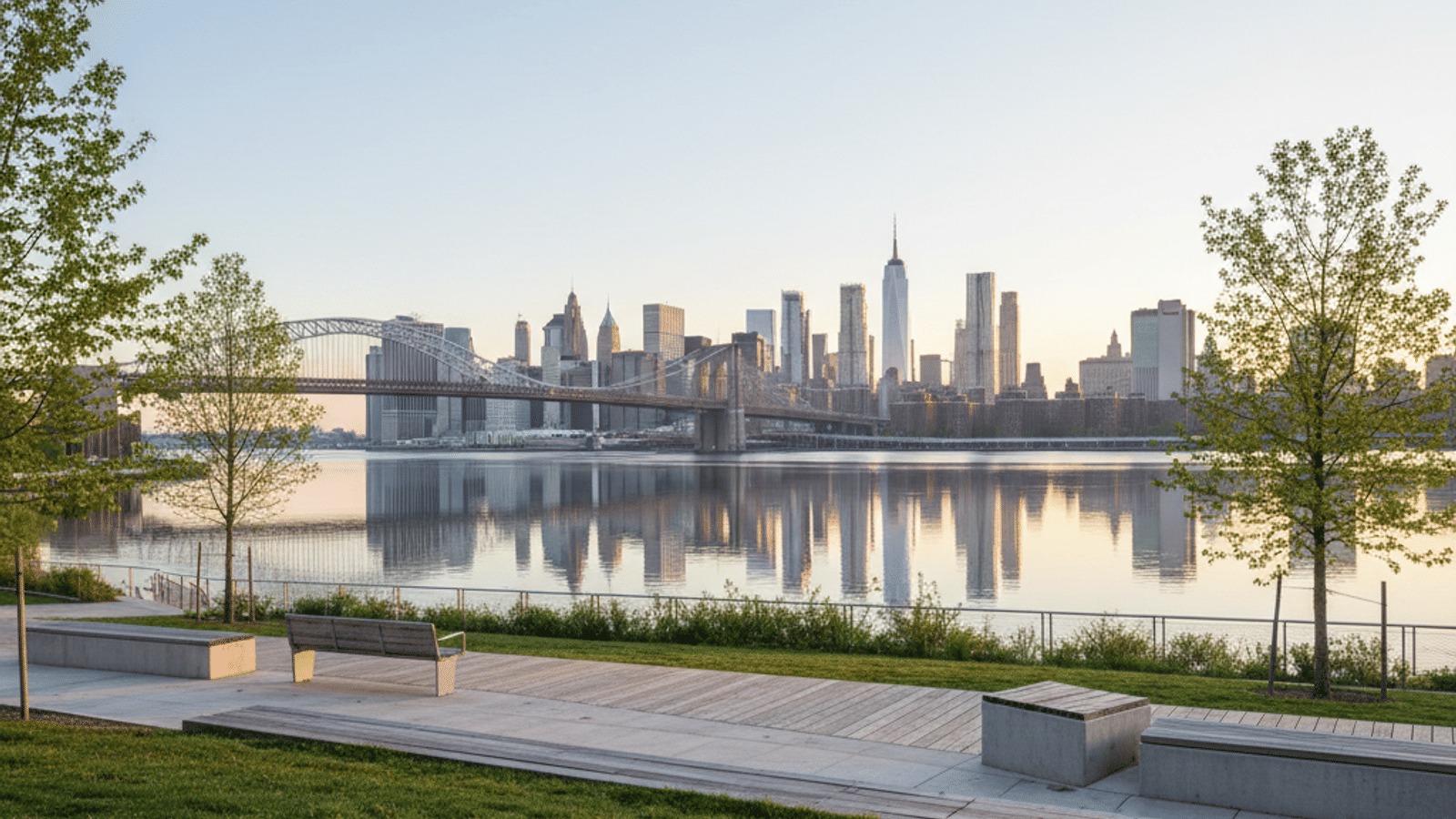
If you are looking for the epicenter of New York City cool, your search inevitably narrows down to two heavyweights: the Lower East Side (LES) and Williamsburg. These two neighborhoods face each other across the East River, connected by the Williamsburg Bridge, but the daily experience of living in the Lower East Side compared to Williamsburg couldn't be more distinct.
On the Manhattan side, you have the Lower East Side. This is "Old World New York." It is chaotic, historic, vibrant, and unapologetically gritty. It’s where the city’s immigrant history meets its loudest nightlife.
Cross the bridge into Brooklyn, and you land in Williamsburg. This is "New Brooklyn." It is spacious, polished, and amenities-focused. It feels less like a chaotic scramble and more like a curated, industrial-chic resort. Deciding between them usually comes down to one question: Do you want to be in the middle of the action, or do you want a view of it from a luxury rooftop?
Vibe and Lifestyle: Grit vs. Gloss
When comparing the vibe of these two areas, think of it as a battle between grit and gloss.
The Lower East Side is high-energy, all the time. The streets are narrow, the buildings are older, and the sidewalks are packed. It is a dense mix of long-time locals who have been there for decades and a Gen Z crowd filling up the bars. You are constantly surrounded by history here, from the tenement architecture to the street art and graffiti that covers the roll-down gates. It’s loud, it’s intense, and for people who love it, that energy is the drug.
Williamsburg, particularly the waterfront area, feels much more polished. It almost operates like a "city within a city." The streets are wider, the sunlight hits the pavement a bit more, and the demographic shifts slightly. While you still have creatives, the crowd here leans toward professionals who have traded the chaos of Manhattan for elevator buildings and proximity to Whole Foods. It’s a creative-meets-corporate atmosphere where the hustle feels a little more managed.
• LES: Best for those who feed off noise, late nights, and historic character.
• Williamsburg: Best for those who want a stylized neighborhood with modern conveniences and breathing room.
Rentals: Tenements vs. Luxury High-Rises
This is where the physical reality of your living situation really diverges, and understanding the cost of living in the Lower East Side versus Williamsburg is essential before signing a lease.
In the Lower East Side, the housing stock is dominated by pre-war walk-ups—classic tenement-style buildings. If you are renting here, you are often looking at smaller square footage, no elevator, and radiators that clang in the winter. While there are pockets of luxury, the default inventory is old-school. You are primarily paying for the zip code and the unmatched Manhattan walkability. A typical 1-bedroom here might hover in the $4,950 to $5,400 range, though the LES does offer some cheaper "entry-level" options in older, non-renovated walk-ups that can lower your monthly overhead.
Williamsburg is the complete opposite. The skyline here is defined by modern glass high-rises where you are paying for a lifestyle of convenience. A huge portion of the rental inventory consists of amenity-rich buildings with gyms, doormen, rooftop lounges, and in-unit laundry. A 1-bedroom here also lands in the $4,800 to $5,000 range, but that price usually includes modern perks you simply won't find across the river. Because of this newer construction, the "floor" for pricing in Williamsburg is generally higher, making it harder to find a bargain compared to the varied inventory of the Manhattan side.
Buying Market: Condos, Co-ops, and Investment Value
If you are looking to buy rather than rent, the market dynamics shift significantly between these two neighborhoods.
Williamsburg is a condo-heavy market. Because much of the area was developed in the last 15 to 20 years, it is much easier to find properties that are friendly to investors, foreign buyers, or those who want to sublet freely. However, this convenience comes at a premium. The median sale price often sits between $1,400,000 and $1,800,000, with price per square foot pushing $1,500.
The Lower East Side market is more complex, consisting of a mix of co-ops and condos. The market stats here can be misleading because the area contains many HDFC (income-restricted) co-ops that sell for lower prices but have strict eligibility caps. For market-rate buyers, inventory is split between strict co-op boards in historic buildings and ultra-luxury new condos.
An often-overlooked factor for buyers is the accessibility of education; many families are drawn to the area specifically because of the highly-rated schools in Lower East Side NY, such as NEST+m and PS 184 Shuang Wen. This academic reputation adds long-term value to the real estate in the district.
• LES Median Price: Roughly $1,000,000 to $1,200,000, though this is skewed lower by smaller co-op units.
• Price per Sq Ft: Generally around $1,300, offering slightly better value on paper than Williamsburg, provided you are prepared to navigate the co-op board approval process.
Commuting and Transit: The L vs. The F/J/M/Z
How you get to work will dictate a lot of your happiness in these neighborhoods.
Williamsburg is heavily reliant on the L train. It’s incredibly fast to Union Square (about 15 minutes), but it can get crowded during rush hour. For those working on Wall Street or near 34th Street, the NYC Ferry is a major game-changer. It offers a scenic, stress-free commute that feels more like a boat tour than a slog to the office.
The Lower East Side relies on the F, J, M, and Z trains. The connectivity here is excellent, especially if you work in Midtown or the Financial District. The F train gets you to Midtown in about 25 minutes. However, the LES has a superpower that Williamsburg doesn't: walkability. If you live here, you can easily walk to SoHo, the East Village, Chinatown, and depending on your location, even the Financial District. You aren't reliant on a tunnel or a bridge to get to the rest of Manhattan.
Food, Nightlife, and Culture
Both neighborhoods are dining destinations, but the flavor is different.
The Lower East Side is widely considered the nightlife capital of the city. We're talking dive bars, hidden speakeasies, and small venues with loud live music. It stays open later and feels wilder than almost anywhere else in the city. For food, it’s home to iconic staples like Katz’s Delicatessen and Russ & Daughters, alongside a never-ending rotation of cheap eats and hole-in-the-wall gems.
Williamsburg offers a more designed dining experience. The restaurants here are trendy, often spacious, and feature large outdoor dining setups that are rare in Manhattan. It’s also become a major retail hub. While the LES is better for independent galleries and vintage shopping, living in Williamsburg gives you access to major boutique brands and convenient retail like the Apple Store, Supreme, and massive grocery stores.
Parks and Waterfront Access
If green space is a priority for you, Brooklyn generally wins this round.
Williamsburg has aggressively developed its waterfront. Domino Park is one of the best designed parks in the city, offering stunning skyline views, taco stands, and lounge chairs. Marsha P. Johnson State Park also provides wide-open access to the river. It feels open, airy, and livable.
The Lower East Side feels much more concrete-heavy. While there is East River Park, much of it has been entangled in long-term resiliency construction projects, limiting access to the water. There are smaller pockets of green like Seward Park, but generally, the LES feels more enclosed and urban compared to the open skies of the Williamsburg waterfront.
Pros and Cons at a Glance
Sometimes it helps to have the trade-offs cut and dried for a view.
• LES Pros: Unbeatable Manhattan location, authentic "old NYC" character, excellent subway variety, and walkable to other cool neighborhoods.
• LES Cons: Noise levels, unit sizes for the money, and overall grit and cleanliness on the streets.
• Williamsburg The Pros: Contemporary conveniences (dishwashers, elevators), amazing waterfront parks, and a “resort” ambiance that blurs the line between work
• Williamsburg Cons: Dependence on the L train, may be very touristy or commercial on weekends, and very expensive pricing for condos.
The Verdict: Which Neighborhood Fits You?
Ultimately, the choice between the Lower East Side and Williamsburg depends on what stage of life you are in and what you value in a home.
If you are seriously considering moving to Lower East Side NY, choose this neighborhood if you crave raw energy. It is the perfect home base for the person who wants to feel the pulse of New York the second they step out of their door, valuing history, grit, and the convenience of being able to walk home after a late night out. It’s for those who hate the idea of "commuting" into the city because they are already at the center of it.
On the other hand, choose Williamsburg if you want the "soft life" without leaving the cool zone. If you prefer a modern apartment with a gym, enjoy morning runs along the water, and don't mind a short train or ferry ride to reach Manhattan, the Williamsburg lifestyle is hard to beat. It offers a curated, polished version of the city that serves as a calm retreat from the midday hustle.
FAQs
Is the Lower East Side cheaper than Williamsburg?
Not necessarily. While the Lower East Side has some cheaper, older walk-up apartments that bring the average down, luxury rentals in the LES are just as expensive as Williamsburg. In terms of buying, Williamsburg generally commands a higher price per square foot due to the abundance of new construction condos.
Is the Lower East Side safe compared to Williamsburg?
Both areas are busy and generally popular, but they feel different. The Lower East Side is a high-traffic nightlife district, meaning it is louder, grittier, and more chaotic late at night. Williamsburg, particularly away from Bedford Avenue, has a quieter, more residential feel with wider streets that some residents find more comfortable.
How long is the commute from Williamsburg to Manhattan?
It is very fast. The L train can get you from Bedford Avenue to Union Square in Manhattan in about 15 minutes. If you are taking the Ferry to Wall Street, the ride is roughly 20 minutes, making it a very convenient commute for downtown workers.