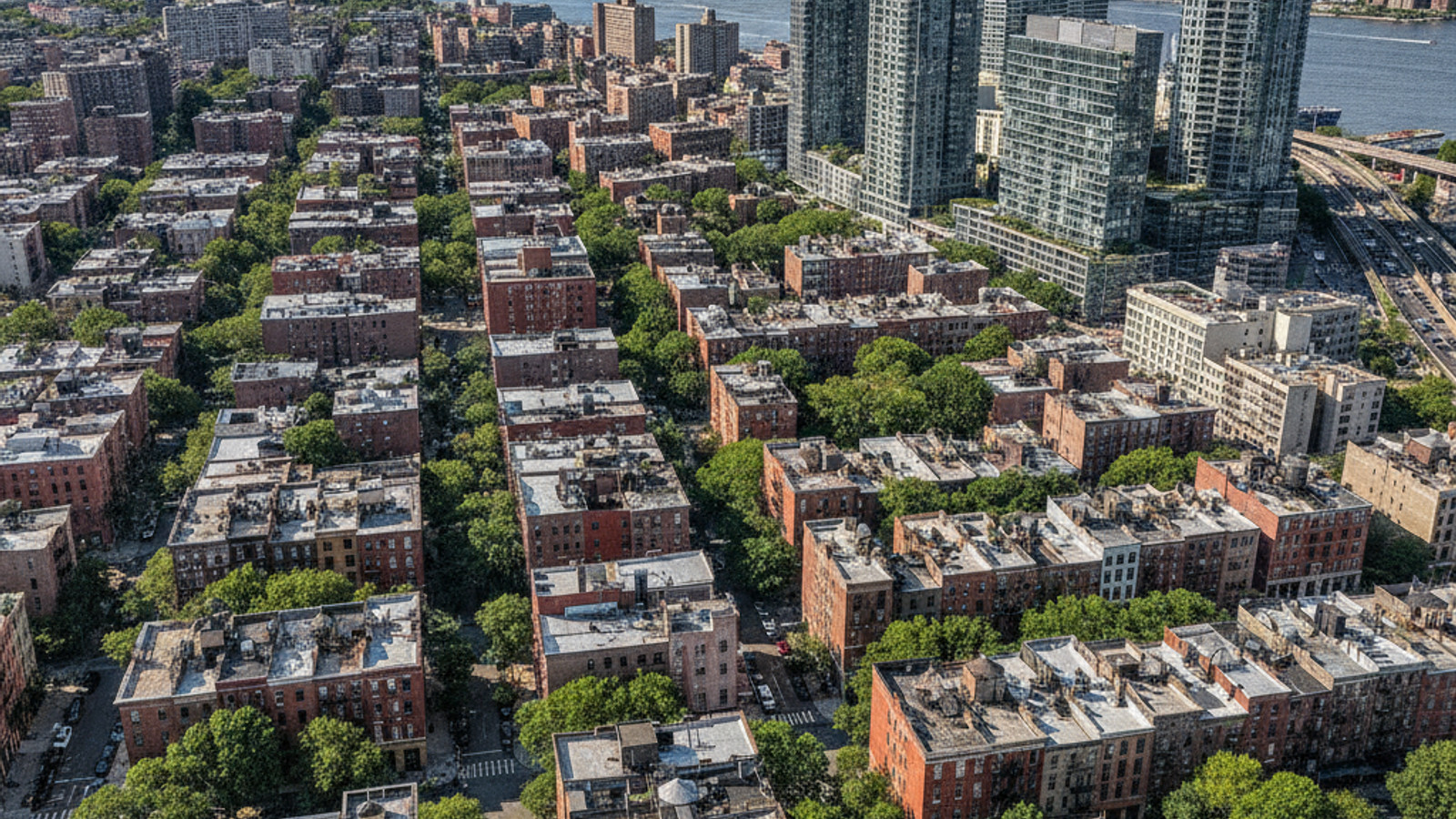
Houston Street serves as the dividing line between two of downtown Manhattan's most discussed real estate markets. Buyers and renters looking south of 14th Street often find themselves weighing the Lower East Side vs East Village. These adjacent areas share a long history of tenements and immigration, but they have evolved into distinct property markets with different housing styles.
Both neighborhoods offer pre-war walk-ups and access to the East River, but the building stock and price points diverge the further south you travel. Choosing between them comes down to transit preferences, budget, and whether you prefer historic co-ops or modern waterfront condos.
The Houston Street Divide
The East Village spans from 14th Street south to Houston Street, bordered by the East River to the east and the Bowery to the west. The Lower East Side picks up immediately below Houston Street, stretching south to Canal Street.
A century ago, this entire stretch was considered one massive immigrant district defined by New York State Tenement House Act architecture. Real estate agents began marketing the northern section as the "East Village" in the 1960s to associate it with the neighboring Greenwich Village. Today, both areas retain their historic masonry facades, but zoning changes have allowed different types of development in each.
The East Village maintains a lower skyline due to preservation efforts and neighborhood zoning caps. South of Delancey Street, the Lower East Side features a growing number of high-rise glass towers, particularly along the waterfront.
Property Prices and Market Trends
Median home values in the East Village sit around $1.18 million as of mid-2026. The Lower East Side offers a slightly lower entry point for buyers, with median sale prices hovering near $980,000.
Renters face a different dynamic, as the Lower East Side's newer luxury inventory pushes its median rent to roughly $5,900 per month. East Village median rents are slightly lower, averaging around $5,770. Both neighborhoods have plenty of historic pre-war co-ops featuring exposed brick and walk-up access.
The defining difference in housing stock is the presence of new construction. The Lower East Side has seen steady development over the past decade, resulting in amenity-rich condos with doormen and skyline views. The East Village remains dominated by smaller co-op buildings and townhouses, making it harder to find in-building gyms or private parking.
Subway Access and Commute Times
Transit options shift dramatically depending on which side of Houston Street you live on. The East Village relies primarily on the L train running along 14th Street and the Union Square transit hub. The Lower East Side depends on the F, M, J, and Z trains running through the Delancey/Essex station and the East Broadway stop.
Commuters traveling to Midtown or the Financial District should factor these specific lines into their daily routes. Here is how the transit setups compare:
- East Village: Residents near Alphabet City often face a 10-to-15-minute walk to the First Avenue L train or Astor Place 6 train. Union Square provides access to the 4, 5, 6, N, Q, R, and W lines for a direct commute to Midtown.
- Lower East Side: The Delancey/Essex station connects directly to Brooklyn and Midtown via the F, M, J, and Z lines. The East Broadway F station serves the southernmost blocks near Canal Street.
- Bridges: The Lower East Side offers direct access to the Williamsburg Bridge and Manhattan Bridge, providing dedicated bike and pedestrian paths into Brooklyn.
Parks and Outdoor Recreation
Tompkins Square Park serves as the central outdoor gathering space for the East Village. This 10.5-acre park spans from Avenue A to Avenue B, featuring mature elm trees, basketball courts, and the city's first recognized dog run.
The Lower East Side centers around Seward Park, which sits at the corner of Canal Street and East Broadway. It provides sports courts, a playground, and a branch of the New York Public Library. Both neighborhoods also share access to the East River.
East River Park runs along the waterfront for both districts, offering a running track, tennis courts, and soccer fields. Ongoing coastal resiliency renovations have temporarily closed certain sections of this waterfront over the past few years, shifting how residents access the river paths.
Dining, Shopping, and Entertainment
The commercial corridors in these two neighborhoods offer distinct retail setups. The East Village features dense blocks of independent restaurants, dive bars, and vintage clothing stores, particularly along 8th Street, St. Mark's Place, and Second Avenue.
The Lower East Side leans toward boutique shopping and contemporary art galleries. Orchard Street, Ludlow Street, and Delancey Street host a mix of upscale dining, speakeasies, and historic establishments like Yonah Schimmel's Knish Bakery.
Everyday conveniences are available in both areas, but the layouts differ. Here is a look at the commercial landscape:
- East Village: Grocery options include Trader Joe's on 14th Street, Key Food on Avenue A, and numerous corner bodegas. The nightlife is concentrated in Alphabet City and along the avenues.
- Lower East Side: The Essex Market provides an indoor food hall with specialty grocers, butchers, and fishmongers. Target and Trader Joe's operate large locations at the Grand Street intersection.
Schools and Healthcare Access
Both neighborhoods fall within New York City School District 1, which covers the southeastern portion of Manhattan. This district employs a choice-based enrollment system for elementary and middle schools, meaning residents are not automatically assigned to a single building based on their address.
Healthcare infrastructure in downtown Manhattan underwent a major shift following the April 2025 closure of Mount Sinai Beth Israel. The permanent shutdown of this long-standing hospital removed the primary emergency room servicing the immediate area.
To replace the lost hospital capacity, Mount Sinai opened an expanded urgent care center on 14th Street. Residents requiring full emergency room services or specialized hospital care now travel to NYU Langone Health in Kips Bay or NewYork-Presbyterian Lower Manhattan Hospital near City Hall.
Frequently Asked Questions
Is the East Village considered part of the Lower East Side?
Historically, the area north of Houston Street was part of the Lower East Side. Real estate agents coined the term "East Village" in the 1960s to rebrand the northern blocks. Today, the city recognizes them as two separate neighborhoods with distinct community boards.
How do crime rates and police response times compare?
Both neighborhoods are patrolled by the NYPD, with the 9th Precinct covering the East Village and the 7th Precinct covering the Lower East Side. Crime statistics closely mirror the Manhattan average, with property crimes like package theft being the most common complaints in both areas.
What salary do I need to rent an apartment in these downtown Manhattan neighborhoods?
Landlords in New York, NY typically require tenants to earn 40 times the monthly rent. With median rents approaching $5,900 in the Lower East Side and $5,770 in the East Village, a household needs an annual income of roughly $230,000 to $236,000 to qualify for a standard lease.